

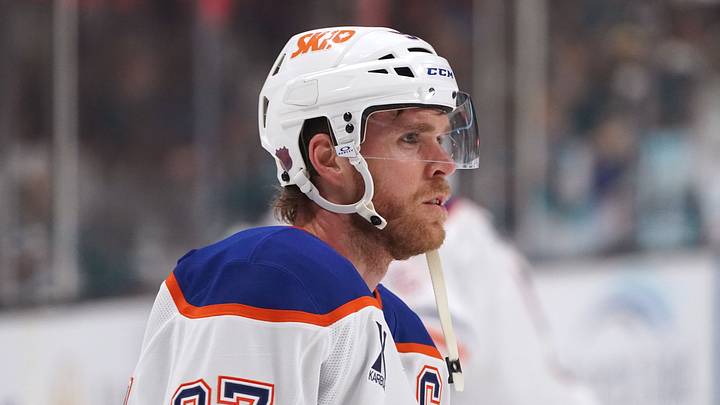
The two-year extension Connor McDavid signed just last year might only now be kicking in, but his future as captain of the Edmonton Oilers is still very much in doubt.
And Tuesday's offseason/pre-training camp developments did no service for the case in favor of McDavid staying with the Edmonton Oilers.
In Minnesota, defenseman Quinn Hughes remains without a contract extension even with in mind. But a recent development claimed that Hughes doesn't know what he wants to do beyond the 2026-27 campaign.
This latest update is twofold: Elliotte Friedman said any extension with Minnesota would likely be a short-to-medium-term deal, while Chris Johnston added that Hughes isn't ready to commit to it, given his desire to team up with his two brothers, Jack and Luke, whether in New Jersey or elsewhere. It did clarify that Minnesota's front office is willing to make the financial offer to Hughes that helps to keep him in town for the foreseeable future, but that it all depends on what the former Canucks defenseman wants.
Over in Ottawa, the fallout from the Brady Tkachuk trade continues to fall on Canada's capital like it's your typical Ottawa winter: snowy, slushy, and a little too cold for one's liking. The Prairies might want a word, but I speak from experience.
Weather aside, longtime Ottawa Senators defenseman/contender for the team's vacant captain role Thomas Chabot took the time to address Tkachuk's departure during the team's charity golf tournament and just two weeks ahead of their preseason opener in Trois-Rivières, where they will play the Montreal Canadiens.
In the press conference, Chabot hit a lot of noteworthy points. These included a shared feeling of frustration surrounding the timing of Tkachuk's decision to leave and how the trade request reinforces the team's mentality.
These might be two distinct cases, but do they paint a bleak future for McDavid in Edmonton?
By now, we're all aware of the potential situation that the Oilers could find themselves in one year's time.
To put it simply, McDavid is eligible to sign an extension to his current contract next summer, and he'll be able to sign a brand-new deal the following year. He's currently 29, and he'll be in his thirties when he becomes eligible for an extension.
That should put him in an interesting bind: does he continue to give his all to the Oilers and commit to finishing his career in orange and blue? Or does he opt to test the waters elsewhere should the Oilers continue to fall short of expectations?
Unlike Tkachuk, who is in a fairly similar contract situation, McDavid will play the penultimate season of his deal in Edmonton. That much is not in any kind of doubt.
But anything can happen, especially in today's sports world. That's why one must be mindful of what Tkachuk just pulled, and what others like Connor Hellebuyck and Dylan Larkin, both of whom have significantly more term than all three of the players I've mentioned thus far, are attempting in their own respects. Even if one remains committed to a team on the surface level, be it via media commentary or extensions, there might be things happening within the locker room or between a player and their front office that might trigger a souring in relations.
It's also worth noting that the Oilers' locker room could very well band together in absence of their captain and say "hey, we can't let this distract ourselves from putting our best foot forward. Either he commits to helping us and being a leader, or we move on." That's more or less how the Senators' locker room felt following the Tkachuk trade.
Even though McDavid remains committed to the franchise at the surface level and things between him and the team as a whole remain positive, especially in terms of the Mike Babcock hiring, a poor campaign could easily change things.
Where Hughes' situation comes into play is with regard to any potential extension/re-signing in Edmonton.
If McDavid were to go to the Oilers' front office on July 1, 2027, and say "I want an eight-year deal at $19 million per year", they would surely hand that money over to him with a smile on their face.
If McDavid were to go to the Oilers' front office on that same date but instead say "I'm not sure if I want to stay. I like playing in Edmonton, but I no longer feel confident that I can win a Stanley Cup here", then they would scramble to trade him with panicked expressions on their faces, looking to get the best possible return for the superstar before he heads to free agency. They would then be left with no other choice but to watch him fly out of the Edmonton International Airport while crying (I am confident that handkerchiefs and tissue paper would be in high demand in Edmonton if that happened).
The point I am trying to make here is that if there was even a shred of uncertainty surrounding McDavid's willingness to remain in Edmonton, the Oilers' front office would be exploring the possibility of a trade to maintain their place in the Western Conference hierarchy while shifting the franchise's centre of attention to Leon Draisaitl.
In a way, that is similar to what is going on in Minnesota. In stating his perception of Hughes' contract preference, Friedman added that he is set to meet with the Wild's front office in order to establish what's next. That meeting could provide much-needed clarity in terms of the whole Hughes situation, especially with just one week left before the Wild cannot lock him into an eight-year deal. A straight no or noncommittal answer from Hughes in terms of an extension in Minnesota could open a window for the Wild to trade the defenseman, especially if he is going to soon commit to joining his siblings regardless of what happens that season.
When McDavid once again becomes eligible to negotiate a new deal, the focus is going to shift back to the question of whether he wants to remain in Edmonton or pursue a new challenge. If it becomes clear that the latter option will prevail over the former, then the Oilers' front office will face the same bind that Minnesota is set to potentially contend with and that Ottawa only just dealt with.
 Add us as a preferred source on Google