

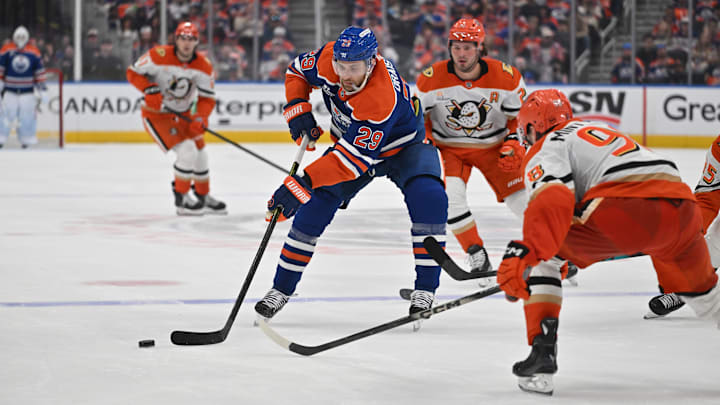
With 7:18 left in the third period of Game 1 between the Anaheim Ducks and the Edmonton Oilers, forward Zach Hyman was the victim of a reverse hit from third-year Ducks defenseman Jackson LaCombe.
Despite Hyman's ability to tough out big hits, this one required a look from the Oilers' staff, forcing the Toronto native out of action for a brief moment.
While Oilers fans were understandably upset about the no-call that resulted, especially considering that Hyman only recently returned to action, it's not necessarily a penalty that is called. The rules implicitly go after it through wording like "deliberate check", but Rasmus Dahlin's reverse hit on Nico Hischier in 2023 did earn a "no call" from the officials, so there is precedence to use that ruling on such a play. That said, Mike Matheson earned a $5,000 fine for a reverse hit on Eric Staal during a game between Matheson's Montreal Canadiens and Staal's Florida Panthers during the 2022-23 regular season.
With that out of the way, I have to pull myself away from the legal talk and get back to the hockey. And I do so by asking the following question: Does LaCombe's reverse hit on Hyman, as questionable as it is uncalled on the ice, symbolize a wake-up call for those who thought this would be a quick series?
It's important to note that the Oilers did slightly out-hit the Ducks in Game 1 ...
Even with LaCombe's big hit on Hyman in mind, the Oilers still won that stat category by a 46-37 scoreline.
But that margin could have been far smaller, if not reversed in Anaheim's favor. Anaheim had four players record 100+ hits during the regular season, while eight total players recorded at least 90 hits. As for the Oilers, just five players recorded more than 90 hits on the season. On that note, it is worth noting that Podkolzin, who led the Oilers in hits during the regular season, recorded 50 more hits than the Ducks' leading hitter - Ross Johnston - and almost 80 more than defenseman Radko Gudas.
... but Anaheim matched Edmonton in other areas of physical-style hockey
In terms of shots blocked, Anaheim was able to hold Edmonton to a 19-all draw. That is especially important when considering that the Oilers only outshot the Ducks by a 34-28 margin, meaning that the Ducks did well to slow the Oilers' offensive machine down and physically stop pucks from getting to the net.
All of the above together gives the Ducks plenty of reason to be happy with their Game 1 performance against the Oilers, one that could have easily resulted in a 1-0 series lead for the Ducks.
That said, the Oilers should reward the Ducks' effort with a far stronger Game 2 performance. Getting Anaheim moving defensively - be it by faking shots, toe drags, or other means - will be key to taking away their blocked shot opportunities. The Oilers will also need to move the puck a lot quicker than they did in Game 1, especially when operating from the blue line.
The Ducks' ability to keep pace with the Oilers physically in Game 1 should serve as a major point of concern in the time between Game 1 and Game 2. But the Oilers are more than capable of getting the Ducks off their game, and a more dominant Game 2 performance in terms of the physicality-based stat categories could easily shift the series in their favor entirely as Anaheim prepares to host its first playoff games in eight years.
 Add us as a preferred source on Google