

"[Brett] Kulak wins it! The Avalanche move on!"
I'm aware that Brett Kulak and the Colorado Avalanche have nothing to do with the content of this piece, but they now are.
Such is especially true when considering that Minnesota Wild fans are probably not going to be very happy after losing a game to the Vancouver Canucks and a chance to trade for yet another Team USA star. All in the span of 24 hours.
Not only did Connor Hellebuyck end up in New Jersey alongside Golden Goal-scorer Jack Hughes, but Dylan Larkin also snubbed Minnesota for the tricolore of the Montreal Canadiens.
Yes, I'm as stunned as you are.
A move as out of left field as George Springer's World Series berth-clinching home run (sorry Seattle Mariners fans, this had to be done).
To discuss the trade, Larkin will be heading to Montreal alongside a 2028 second-rounder and a 2027 third-round selection with him. In exchange, the Detroit Red Wings are getting forwards Kirby Dach and Michael Hage, goaltender Samuel Montembeault, and a series of picks. The first two picks are top-10 protected first-rounders and will come in 2027 and 2029; those will be sent alongside another pick in the 2027 draft (a second-rounder) and a mid-round selection in 2028 (a fourth-rounder).
Here's my take and how the Edmonton Oilers lost the chance to make that same trade.
The Red Wings are still a playoff team, but Montreal's time is now
Say what you will about the Wings' inability to piece wins together, but I think the return keeps Detroit in the playoff conversation. It might not mean that they are instantly a playoff contender this season, though wins in their next two games against the Vancouver Canucks and Columbus Blue Jackets could change that trajectory, but it more than certainly makes them a threat to contend over the next few seasons.
Even with Larkin leaving, Detroit's core is still in place. Lucas Raymond and Alex DeBrincat, the latter of whom just signed an extension to stay in the Motor City until the mid-2030's, are the two centrepieces of the forward group. Moritz Seider will lead the defense for the long-term, though others like Ben Chiarot and Jacob Bernard-Docker are set to be in tow beyond this season.
If Detroit can get things turned around, they have the pieces to support those players. But if not, they'll be able to make some moves around the lineup to either get some players with term on their contracts or build up their chest of draft picks to use in a bigger offseason move. The Red Wings will remain under the spotlight in this regard as time continues to tick on Simon Edvinsson's trade saga; given how much Larkin brought in for the team, it's fair to assume that the Red Wings could get some value for a defenseman who recorded 31 points in his first full campaign.
What else helps the Red Wings is that they are projected to have almost $60 million in cap space for next season. That's more than enough to get Hage locked up to an entry-level deal, get him into the lineup, and contend for multiple big-name free agents like Jason Robertson or even Alexander Nikishin.
Even if the Red Wings don't make the playoffs this year, they are going to control what happens in the NHL for the short, medium, and potentially the long-term. And whatever happens with Edvinsson could easily position them for a long-awaited postseason return.
For the Habs, acquiring Larkin essentially fills every need that they have ever needed to address during the last five years.
They have their star forwards in Nick Suzuki and Cole Caufield. They helped them navigate the toughest years of their rebuild.
They filled their needs at defense. They got Lane Hutson into the lineup and traded for Alexandre Carrier to reinforce that end of the ice; those moves helped get the Habs into the playoffs for the first time since 2021.
They got much younger at the goaltending position. Though the Larkin trade formally brings the Montembeault saga to an end, any Habs fan could have reasoned that Jakub Dobes and Jacob Fowler were the future at that position.
And will all the depth that they have acquired, which includes Alex Newhook and Noah Dobson, the Habs finally got back to the depths of the postseason last spring.
After offseason talks of needing a second centre and having to lock everyone up to extensions, the Habs did that and then some.
How the Oilers lose, plus the connection to the trade
The Larkin trade should at least put any theories of Team USA stars deliberately abandoning Canadian franchises through another evaluation or even to rest in their entirety. For all the talk surrounding the Tkachuks and Quinn Hughes going south of the border, the fact that Larkin wanted to and chose to go to a Canadian franchise easily counters that theory.
But given that Larkin ultimately went to a Canadian team, the trade represents a blow of sorts for the Oilers.
Sure, there's no official word that the Oilers made any kind of bid for Larkin. And yes, Larkin and the Habs successfully and understandably kept any word of a potential trade to Montreal out of media circles.
But if the Oilers were intent on solving their forward depth issues, they could have easily replicated the package that Montreal strung together in an effort to get Larkin and Detroit's attention.
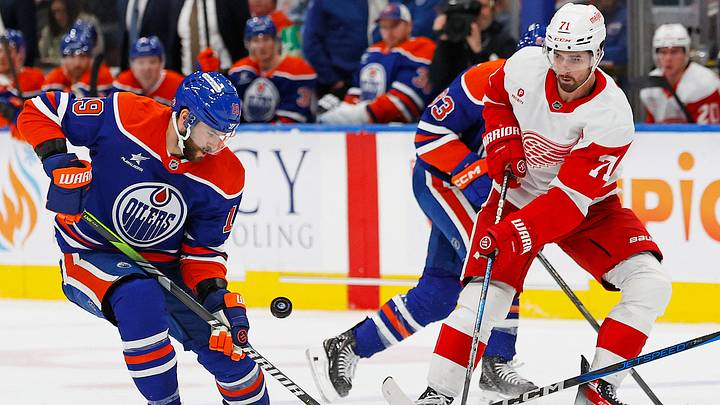
Whereas Montreal sent Dach and Hage from their pool of forward players, Edmonton could have matched that return with Owen Michaels and Trent Frederic, the former of which is far closer to NHL-ready than his NCAA counterpart. And where Montreal sent Montembeault, the Oilers could have countered with Matt Tomkins or even Connor Ungar.
Even then, there is still some connection between the Oilers and the Larkin trade; Dach's brother is Oilers forward Colton Dach.
Where Canada's Stanley Cup hopes go from here
There have been way too many close calls since the Canadiens last brought the Stanley Cup north of the border.
The Canucks' two runs to Game 7 of the Stanley Cup Final in 1994 and 2011.
The Oilers' three Stanley Cup Final appearances, two of which saw the team get to a Game 7.
The Calgary Flames and their close call against the Tampa Bay Lightning.
The Canadiens and Ottawa Senators each getting to a Cup Final but losing in five.
Even with all of those on-par-to-marginal shortcomings in mind, and even when considering that we are only two campaigns removed from five of seven Canadian teams getting into the postseason, this season might very well be Canada's best chance to take home the Stanley Cup.
Outside of the Oilers' 17-5-4 start to the season, the Sens and Habs are both in the Atlantic Division's top three; the former enters Monday's action with the lead in the division. At the same time, both the Flames and Winnipeg Jets are well within striking distance of a playoff spot of some kind.
With Larkin now in tow and with Edmonton holding their own out west, Canada has two top-tier Stanley Cup contenders, one on each side of the bracket.
 Add us as a preferred source on Google