

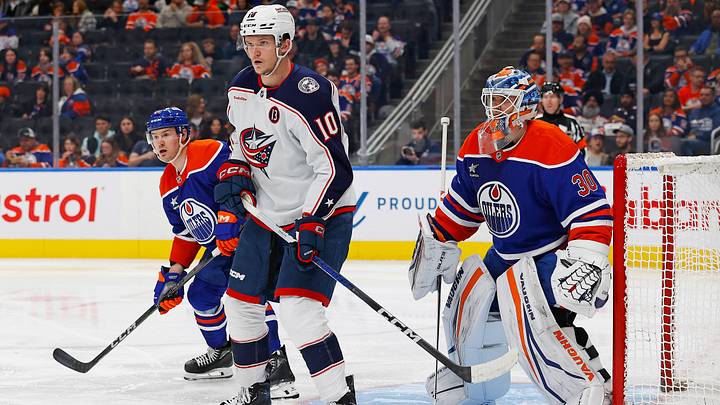
The Columbus Blue Jackets might be in a playoff-or-bust season, but it's clear that they're closer to the median than the postseason.
After their first 15 games of the season, the Blue Jackets are 7-8-0 and have failed to gain much in the way of momentum. While they currently sit in sixth in the Metropolitan Division and six points back of a playoff spot, they've also scored just 40 goals, which is the second-fewest of any team in the Eastern Conference.
Even then, it's clear that the team is not willing to sit around and do nothing. They've moved defenseman Emil Andrae, who was part of the return in the Kirill Marchenko trade, and forward Danton Heinen to their AHL affiliate (the Cleveland Monsters) in the hopes of clearing cap space for a move elsewhere. Doing so would give the team's front office the chance to finally prove to Zach Werenski, who has spent his entire career in Columbus, that they can once again build a team that is capable of competing for a playoff spot and making noise in the postseason.
After all, Werenski was part of the Blue Jackets team that, back in 2019, upset a Presidents' Trophy-winning and record-setting Tampa Bay Lightning.
That strategy could be a double-edged sword
On one hand, the Blue Jackets could move closer towards playoff contention by flipping Heinen and Andrae for a win-now type of contributor. That hope is helped by the fact that Andrae is a mobile defenseman that can help inject life into an offense and that Heinen is a veteran forward who does represent Mike Babcock's coaching style and can produce offensively albeit more often in smaller sample sizes.
On the other, the team is going to have to manage this situation while dealing with the future of forward Dmitri Voronkov, who is one-season-and-a-month removed from a 47-point campaign. And there is interest across the league and potential value for such an acquisition. According to Pierre LeBrun, inquiries were made concerning Voronkov's status; it remains to be seen how far along such talks got, who even made the calls, or what Columbus' trade strategy even is.
The latter idea is worth considering when it comes to thinking about Columbus' recent trade history. When the Blue Jackets flipped forwards Marchenko and Miles Wood alongside goaltender Elvis Merzlinkins for Toronto Maple Leafs forwards Matthew Knies and Steven Lorentz - who went to Columbus alongside defenseman Andrae and a second-round draft selection - one could reasonably assume that the combined experience and physicality brought by the former two would help Columbus contend for a playoff spot.
In reality, the Blue Jackets lost that trade. Even though Marchenko is currently out with an injury, he was averaging a point per game in his first 14 appearances for the Leafs. At the same time, Knies has just six points over that same span of games, while Andrae had put two assists on the board before being sent to the AHL.
So maybe the Blue Jackets need to stay away from the three-player trades?
Enter the Edmonton Oilers.
It would probably be the most head-and-eye-scratching trade (more eye-rubbing, but you get what I'm trying to say here) of the Stan Bowman era, but the front office could make a trade for all three players at once.
Like the Blue Jackets, the Oilers are cap-crunched at the moment and are hoping to improve their roster while remaining in line with the $104 million salary cap limit.
For the Oilers, acquiring all three players would represent a discount of sorts. Though Voronkov's AAV is equal to $4,175,000, Heinen's contract is only worth $1 million annually, while Andrae has two years left on a $1,550,000 per year deal.
Together, all three players make $6,725,000, which is equal to what some middle-to-top-line players make in a year. The AAV attributed to the contract of Ottawa Senators forward Dylan Cozens is just about $400,000 greater than the aforementioned value, while Colorado Avalanche defenseman Devon Toews' contract value is only a little bit higher than that of Cozens.
That should also be the number that the Oilers' front office targets in any trade, both in terms of how much cap they're willing to take in and whether they can try and improve their salary situation in any capacity. Moving defenseman Jake Walman would easily put the Oilers ahead by $275,000 and allow them to try something new at that end of the ice.
That said, the Oilers still have to create space on the roster for another two forwards, and Columbus is more than certainly not going to want just one player back in this deal.
And given that it is a player with as many documented struggles as Walman, the Oilers will need to include additional compensation. At minimum, that will include retaining a good portion of Walman's salary, which could end up being anywhere between $2 and $4 million on an annual basis. Columbus could also ask for a forward to be part of the deal; my prediction is that Max Jones and his $850,000 cap hit would be part of such a return.
Though the Blue Jackets aren't necessarily a super-aggressive team, Jones would fit the kind of principles that define Rick Bowness' coaching style. He's a forechecking forward and his size gives him the ability to consistently bring a physical element that is indirectly permitted through the quick-and-high-impact strategy that Bowness employs.
To complete the trade, Edmonton would have to send Columbus either another forward (they could get away with including a prospect rather than another depth piece) or a draft pick of some kind. But if the Oilers had to absorb $2 million per year on what remains of Walman's deal, they would only be able to come out ahead financially by moving a forward with a cap hit akin to that of Isaac Howard.
Edmonton takes a bit of a risk when it comes to acquiring Andrae and Heinen's contracts, especially when considering that acquiring the former while sending Walman essentially acts a one-for-one swap. That said, it could be a fresh start kind of situation when it comes to bringing both players into the fold; the same would apply to Walman's case if he were to be traded.
At the same time, the Oilers get a capable forward in Voronkov who could easily help them fill a middle-six line. That would allow Babcock to reinvent the offensive side of the ice a little bit; he could put Colton Dach back on a more physical forward line, while Voronkov could find himself on a line with Ryan Nugent-Hopkins and Kasperi Kapanen. Given Dach's form, the arrival of Voronkov could allow Babcock to move the former down the lineup and spread the scoring out a little bit.
This could be an intriguing trade that allows the Oilers to reset their defensive depth and move some scoring around. There is definitely some risk attached to it, but I could definitely see the Oilers looking at this kind of a move and giving it some thought.
 Add us as a preferred source on Google