

"Go to 86 games and 0 preseason."
That's how Carolina Hurricanes head coach Rod Brind'Amour described this new version of the NHL's preseason while on Overdrive.
To an extent, he's right.
Too many games causes injuries
We've seen examples in the past preseason format of established players getting injured during competition and being forced to miss considerable amounts of time once the regular season got underway. A few seasons ago, Montreal Canadiens forward Patrik Laine was forced to miss a few months of action because of a knee sprain that he sustained during a preseason contest against the Toronto Maple Leafs.
Concerns about the preseason and player workload were seen to have been addressed by the new Collective Bargaining Agreement and the schedule changes that came from it, but they've recently seen some roadblocks. In Tuesday night's preseason contest between the Buffalo Sabres and the Columbus Blue Jackets, both Mattias Samuelsson and Olen Zellweger exited with injuries; the former left due to the impact of a blocked shot, while the latter sustained a concussion.
Injuries are commonplace in hockey, even during preseason competition, but the latter two cases will ultimately do nothing to disprove Brind'Amour's point.
But instead of abolishing preseason competition, why not give it a new meaning?
After all, preseason can be incredibly meaningful for prospects looking to earn playing time on an NHL roster and veterans looking for a second chance via professional tryout.
Does that mean creating an annual training camp calendar that simply includes four games? Maybe it does.
But if we're talking about getting more attention and momentum around the preseason, then why not try to replicate what other sports are doing? Specifically, cup tournaments.
We see this to an extent in European football. For example, the Football Association, which is the primary footballing organization that oversees English football, organizes an annual preseason Community Shield match that is contested by the winners of last season's Premier League and FA Cup competitions; the latter tournament sees all of England's professional and semi-pro football clubs contest a single-elimination-style tournament throughout the latter half of the year's footballing calendar. It is still seen a preseason fixture, but its qualification technically requires a competitive element and it is viewed as the official kick-off to the year's football happenings.
The same kind of fixture is contested within the footballing systems in other European nations, and UEFA - Europe's governing footballing association - organizes an annual Super Cup that is contested by the winners of the Champions League and the Europa League, both of which make up the top two levels of European club football.
In North America, the NBA created an in-season tournament to add more intrigue to the early-to-midseason contests. That tournament sees the NBA's 30 teams sorted into groups to qualify for a knockout-round tournament and play for the NBA Cup; all games except for the final count towards the regular-season standings.
We also saw the introduction of the Four Nations Faceoff to renew interest in national team hockey, get the momentum going for the Olympics, and lead into further All-Star Weekend reform that saw the traditional All-Star Game revamped into an international tournament.
What the NHL could try to do in this regard is combine the above formats into one. The best way to do this? Regional cup tournaments, with the league's 32 teams divided into eight four-team groups to compete for a trophy that represents the assigned region. The cup tournaments would all have to include a common geographical trait as well as a key NHL rivalry.
While implementing a preseason cup tournament would only renew calls from the likes of Brind'Amour, it would also add more of a competitive element to games played before the NHL's regular season. This would allow established players to feel more comfortable giving their all in preseason games, regardless of eligibility based on the number of games played last season, and give those looking to earn a roster spot a more valuable opportunity to do so.
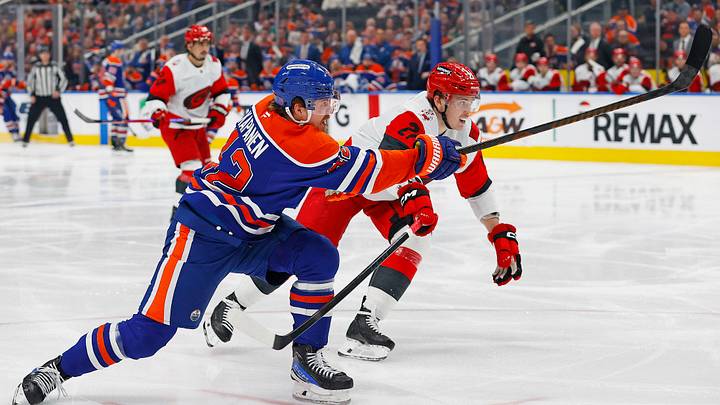
In this scenario, the Oilers would feature in a "Rocky Mountains Cup"
If I were in charge of putting the groups together for this annual cup tournament, I would put the Edmonton Oilers in a group that includes the Calgary Flames, the Colorado Avalanche, and the Utah Mammoth.
Here, you've got the rivalry factor, which takes the form of the Battle of Alberta. You've also got the shared geographic location in the form of the Rocky Mountains; both Denver and Salt Lake City are located in the foothills of the mountains themselves.
The above factors also played a role in the way I set up the remaining seven groups for a potential preseason/regional cup tournament.
How I would set up the other seven groups in a nutshell
West of the Rockies, the Vancouver Canucks would join the Seattle Kraken, Minnesota Wild, and Winnipeg Jets in what would essentialy be a "49th-parallel Cup"; all four teams sit closest to the parallel that separates Canada and the United States from the Pacific Ocean to the westernmost point of the Great Lakes.
The league's southwestern-most teams - the Anaheim Ducks, San Jose Sharks, Vegas Golden Knights, and Los Angeles Kings - would compete in what would be dubbed "The Pacific Cup."
"The Interior Plains Cup" (for lack of a more unique name) would group the Dallas Stars, Chicago Blackhawks, Nashville Predators, and St. Louis Blues.
The NHL franchises based in the southeastern United States - the Florida Panthers, Tampa Bay Lightning, and Carolina Hurricanes - would be joined by the Washington Capitals for an "East Coast Cup."
The Pittsburgh Penguins, Columbus Blue Jackets, Detroit Red Wings, and Buffalo Sabres would all figure into "The Rust Belt Cup" (memories of the late 2000s anyone?)
The Toronto Maple Leafs, Ottawa Senators, Montreal Canadiens, and Boston Bruins would all figure into a "Northeastern Cup" of sorts. Great news for the Habs-Leafs and Habs-Bruins rivalries, terrible news for Sens fans who don't want their arena invaded by Habs and Leafs fans.
The "Delaware River Cup" would see the New York Rangers, New York Islanders, Philadelphia Flyers, and New Jersey Devils grouped together for their own preseason cup tournament.
 Add us as a preferred source on Google