

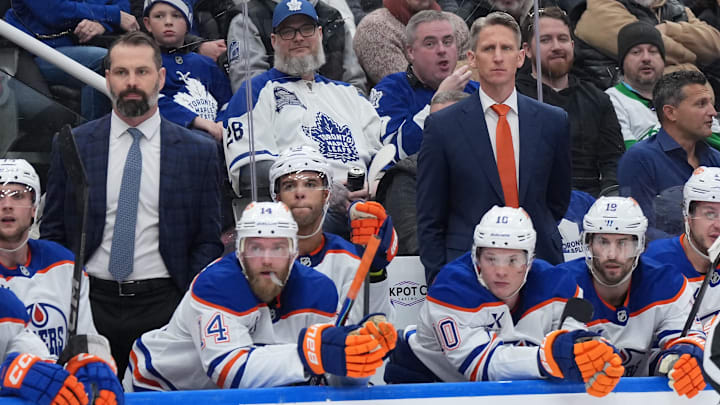
If one is thinking about a head coach who just got his team to two Stanley Cup Finals, they would have to assume that his job would more than likely be safe when compared to other coaches across the NHL.
Despite being spared some criticism by the hockey media due to the team's plethora of injuries, Toronto Maple Leafs head coach Craig Berube is at the centre of some hot seat rumors. The fact that the quasi-Cup-contending Maple Leafs missed the playoffs for the first time since the 2015-16 campaign, which preceded them being awarded the top pick in the 2016 NHL Draft (seems familiar?), is an issue worth forcing everything and anything into question.
Elsewhere, it seems that Carolina Hurricanes coach Rod Brind'Amour is always facing the heat when it comes to playoff hockey. He has responded in kind with a 7-0 start to the Stanley Cup Playoffs, putting his Hurricanes one win shy of their second consecutive trip to the Eastern Conference Finals and, by extension, their third in four seasons.
When one thinks of Edmonton Oilers head coach Kris Knoblauch, there's more than likely two sides to the equation.
One side considers every aspect of the work that he has put in as head coach of the Oilers. Playoff shortcomings aside, this is a head coach who pulled the Oilers from a miserable start to the 2023-24 campaign and put them one win away from their first Stanley Cup since 1990. As the head coach of the Oilers, he's put together a 135-77-21 record for what is roughly a 0.624 points percentage.
For an entire 82-game regular season, that works out to roughly a 100-point season.
The other side basically takes the pro-Knoblauch argument and says "ok, so why have the Oilers not won at least one Stanley Cup?" For all the individual records broken, the second half point-per-game paces, and the international team selections, you'd have to think that the Oilers won at least one Stanley Cup?
Spoiler alert: they fell short twice.
It's also worth noting that the Oilers' points percentage has declined in each of the three seasons since Knoblauch became the team's head coach. In the 69 games that Knoblauch served as head coach during the 2023-24 campaign, the Oilers had a 0.703 points percentage. The next season, the Oilers had a 0.616 points percentage, while the 2025-26 campaign would see the Oilers post just a 0.567 points percentage.
Does that mean Knoblauch is going to be seeing the pink slip? Not necessarily; recent Cup contenders like the Tampa Bay Lightning and Florida Panthers all saw declines in their respective regular-season finishes after winning the Stanley Cup. What mattered the most for those teams was that they got into the playoffs and put themselves in position to go on another run.
But like the 2022-23 Lightning and this past season's Panthers, the Oilers couldn't get back to the Final, as factors like fatigue and injuries caught up to the team and played a role in their first opening-round exit since 2021.
If the Oilers were to therefore take any opportunity to make a coaching change, this extended offseason would be their first chance.
But unfortunately for the Oilers, the market might not be in their favor.
Of the NHL's 31 teams that are not named the Oilers, you could make a fair argument for 26 teams to maintain their coaching staff heading into the 2026-27 campaign. In the Pacific Division, the Kings are expected to undergo a coaching search for next season with current head coach D.J. Smith being given consideration for the role, while the Canucks aren't necessarily ruling such an endeavor out. The Central Division might maintain their entire coaching roster, but the New Jersey Devils and the Hurricanes have their own coaching drama out in the Metropolitan Division. And the Leafs are the only team in the Atlantic that are even in that position.
That does suggest a lack of competition for any top coaches on the market, but it does also suggest a lack of demand.
So the Oilers should naturally look for coaches who aren't currently filling a team's head coach position.
This is where Bruce Cassidy comes into play, but like Knoblauch himself, he comes with a bit of a mixed bag.
The regular-season results are there; Cassidy holds a 470-254-9-95 record as an NHL head coach. From 2017 onwards, he sports a 423-207-89 record, which is good for a 0.650 points percentage. Some of his most notable regular-season records include the 18-8-1 stretch he put together in his first NHL coaching action in 12 years, which helped the Boston Bruins secure a berth in the 2017 Stanley Cup Playoffs.
But the postseason results don't exactly reinforce Cassidy's case. Yes, he's only missed the playoffs once as an NHL head coach (I'm not counting the 2025-26 season as a miss given that he had the Vegas Golden Knights in a postseason spot prior to being replaced by ex-Columbus Blue Jackets bench boss John Tortorella), and he has also won at least one round in six of his 10 trips to the playoffs.
While Cassidy has made it to the Stanley Cup Final twice, winning once with the Golden Knights in 2023, those were the only two times he's made it to the Cup Final.
So is Cassidy simply Knoblauch Mark 2?
I wouldn't go as far as equating one of the NHL's most experienced coaches to a coach managing an NHL team for the first time.
But when it comes to the big picture, there isn't necessarily much to separate the two coaches and, by extension, to justify a coaching change. Both are capable of putting together strong regular season results, but both have had a history of falling short in the playoffs. And both sets of results came with ultra-talented teams; Knoblauch is guiding a Connor McDavid-led Oilers team, while Cassidy managed a Bruins side that still had Brad Marchand and Patrice Bergeron as well as a constantly-superstar-laden Golden Knights team.
Maybe the Oilers continue the fresh-blood approach that has constantly driven the Oilers upward over the past handful of seasons. Maybe they decide to apply a different form of NHL experience towards the coaching of their hockey team.
But at the end of the day, Knoblauch has done a good job setting a standard that many first-time and even some experienced coaches find quite hard to meet.
That alone will make the justification of any offseason coaching change quite difficult in what is already a successful industry.
 Add us as a preferred source on Google