

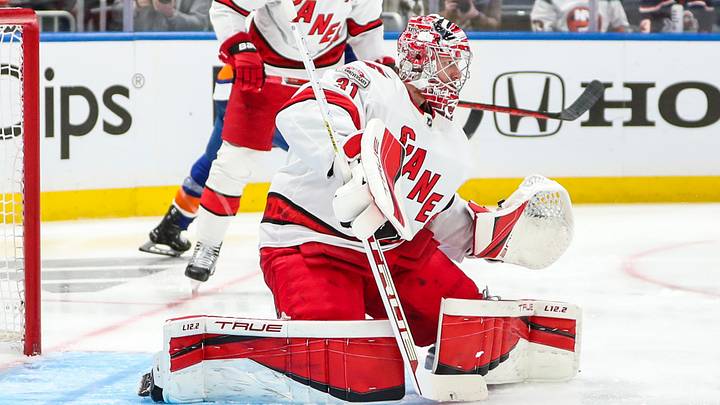
When Frederik Anderson's inexpensive signing was announced, I was as happy as anyone else in the fandom of the Edmonton Oilers. The team's goaltending had let them down in 2025-26 and change was needed. Coming quickly after the news that the team traded for Devon Levi of the Buffalo Sabres, it seemed that there were now both short and long term options in place if Tristan Jarry once again failed to perform. Andersen is also coming off a huge 13-win playoff performance, which only ended due to a knee injury in the Stanley Cup Final.
I have to admit, during the regular season I wasn't paying close attention to the goaltending statistics in the Eastern Conference. Andersen started 35 games, managing a 16-14-5 record, and a save percentage of .875. He faced 849 shots, and allowed 107 goals. In particular, his high danger save percentage (close up shots in the slot, left net, right net) was concerningly low.
Injury and recovery
Given that we now know Andersen had a knee issue that was potentially limiting him, there could be a logical assumption that his lateral movement was affected. An offseason of rehab might correct things, but Andersen, at 36 years of age, even 100% health may look different than his peak years.
For comparison, Jarry played 33 games and managed 18 wins (9 as a Pittsburgh Penguin and 9 as an Oiler). He had a better save percentage (.882) than Andersen but a significantly worse Goals Against (3.32). That is deeply concerning, because it suggests that Carolina's superior shot suppression helped Andersen hit the numbers he did.
One area where Andersen consistently outperformed Jarry was shots from distance. At 0.971, Anderson virtually never allowed goals against via shots from the points. That suggests an elite ability to maintain sight lines on the puck. Even if the Hurricanes defense were great at clearing out screens, the front of the crease is always a busy place.
If we look more directly at the split between Edmonton and Pittsburgh, we are reminded that Jarry really took a step back once the trade happened. His Oilers-only save percentage was .858 and he lost twice as many games on his way to his 9 Oiler wins.
With a new coach and some significant departures and additions, the Oilers' defense will look markedly different in 2026-27, but if Andersen's numbers take a similar dive, we might have to admit that the Oilers were part of the problem. That's not really such a stretch given the team's overall results last season, regardless of who was between the pipes.
 Add us as a preferred source on Google