

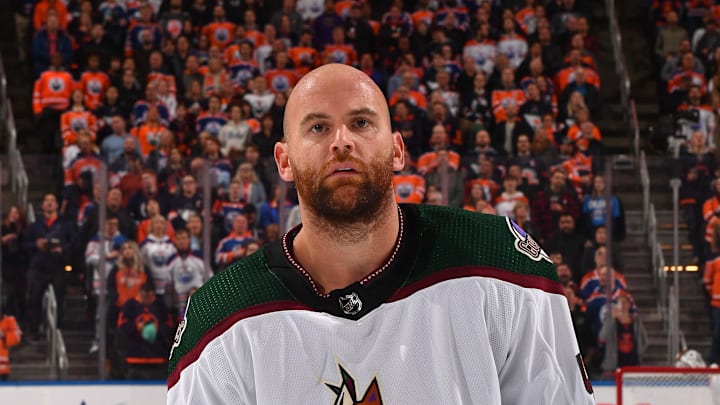
At the 2022 NHL Draft, Zack Kassian was traded by the Edmonton Oilers to the Arizona Coyotes along with the 29th overall pick, a 2024 third-round pick, and a 2025 second-round pick in exchange for the 32nd overall pick.
The move was a pure cap dump. Edmonton was tight against the salary cap and Kassian was making $3.2 million per year for two more seasons and coming off of a season where he had just six goals and nineteen points.
Though he was once a fan favourite in Edmonton, large in part to his physical style and emotional prescence, his production had fallen off significatly from his back-to-back 15 goal seasons and it really seemed it was time for a change. By the summer of 2022, Ken Holland clearly viewed the deal as a mistake and knew he needed to clear cap space at any cost.
At the time, this made a lot of sense on the surface. The Oilers were desperate for a bit of financial flexibility, and in addition to the retirement of Duncan Keith and the news that goalie Mike Smith would miss the entirety of the 2022-23 season with an injury, the Kassian trade gave the Oilers the space to make some moves and hopefully improve their roster in Free Agency.
In hindsight however, this has aged poorly. A second and third round pick is a lot to give up to unload just two years of a marginally bad contract, especially when it only cost the Toronto Maple Leafs thirteen spots in the draft to unload Petr Mrazek's disastrous deal to the Chicago Blackhawks.
Those picks could have been useful for the Oilers, who haven't had a lot of draft capital recently. The Oilers are trying to win a cup so it is imperative to try to win at any cost, so this would be justifiable if the Oilers had used their cap space more wisely, but now, none of the players the Oilers signed that off-season spent the entirety of their contract in Edmonton, except for Ryan McLeod who signed a 1-year deal worth $798,000. Today, I will go through and see how this trade aged.
With that in mind, it's worth revisiting the 2022 Free Agency Class by the Edmonton Oilers to see how this decision aged and if the trade was worth it in the long run.
Evander Kane
After an impressive partial season in Edmonton with 22-17-39 in 43 games following the termination of his contract by the San Jose Sharks, Evander Kane was signed to a four-year deal with a cap hit of $5.125 million.
At the time, there was no question this move seemed justified. He tied Nathan MacKinnon for most playoff goals in 2022 and provided the physical edge the Oilers needed.
However, his time in Edmonton after this would be marred with health issues. Over the next three seasons, he would play in just 118 games including missing the entirety of the 2024-25 regular season. While his offensive production remained solid scoring 72 points (40 goals, 32 assists) in this time, the availability issues combined with his defensive lapses and tendency to take costly penalties at inopportune moments made it so that Edmonton had to move on this past off-season, sending him to the Vancouver Canucks for a fourth round pick which turned into David Lewandowski.
Kane certainly delivered memorable moments at times (who can forget his natural hattrick to come back against Seattle when the Oilers were desperate for a win in 2023) so it's hard to say this was a terrible contract, but again it's clear that the cap space was not used wisely as the contract had to be moved for very little in return. The pick the Oilers got was the same one they had previously given to Vancouver for Vasily Podkolzin. The fact that many fans around the NHL were shocked the Oilers even got that for Kane highlights how quickly the deal turned from great to poor.
Brett Kulak
Brett Kulak was initially acquired by the Oilers at the 2022 Trade Deadline for fellow defenseman William Laggeson and a pair of draft picks. He had an immediate impact to a line-up that at the time, was despeate for a steady defenseman, Many at the time credited Kulak with helping improve the defensive play of his partner Tyson Barrie and he seemed to elevate his game come playoff time. This is why it was no surprise when Kulak was promptly re-signed to a four-year deal with an AAV of $2.75 million.
Kulak gave the Oilers three great seasons. He is not exactly known for his offense with only 71 points (15 goals, 56 assists) in 295 games as an Oiler. However, there is no denying that he was steady on the backend for the team. He was calm and reliable and a perfectthird pairing defenseman who could even handle more icetime if needed.
However, the 2025-26 season was a real struggle in Edmonton. Kulak struggled to maintain his past consitency, at one point going several weeks without being on the ice for a single goal for the Oilers and he noticably was not skating as well. With reports of him wanting to test free agency in the off-season, it made perfect sense to include him in the recent Tristan Jarry trade to free up enough space for the Oilers to be able to acquire the veteran goaltender.
While it would be false to say that this deal did not provide value - the fact that he was essentially a cap dump due to his game falling off (and in a low sample size - he has looked even worse in Pittsburgh) indicates that this deal was likely too long, though for the seasons that Kassian was originally dumped for, he certainly gave the Oilers great value, so this one was at least worth it.
Jack Campbell
In what has gone down as one of the worst moves in the McDavid era, Jack Campbell was signed to a five-year deal with a cap hit of $5 million. After the LTIR-retirement of Mike Smith and Mikko Koskinen going back overseas, the Oilers needed a goalie and the position had been a contentious aspect of the roster for years at that point. With a strong showing in Toronto the year before including an all-star apperance, Campbell was expected to be the starter for a long time. However, optimism on what the affectionally-nicknamed "Soupy" would do in Edmonton quickly faded.
In Campbell's first and ultimately only full season as an Oiler, he had a strong record with 21-9-4 in 36 games but his individual numbers were alarming. He recorded an .888 save percentage and a 4.50 goals against average, among the worst in the league. He had a tendency to allow early back-breaking goals that the Oilers would have to attempt to comeback from.
The Oilers decided to give Campbell another shot the following season and after a strong pre-season, some optimistic fans thought he might be able to bounce back. However, this optimism was short-lived, as in just 5 apperances, he had a 1-4-0 record with an even worse .873 save percentage and a 4.50 goals against average.
The Oilers made the shocking decision to waive Jack Campbell, and despite strong AHL numbers, they were unable to find a trading partner if the off-season. Campbell had to be bought out and will still be getting paid by the Oilers until 2030. Wasting cap space every year when the Oilers have Connor McDavid and Leon Draisaitl is not ideal and Campbell is no longer playing professional hockey in what should be the fourth year of the five-year deal.
Mattias Janmark
Mattias Janmark signed a one-year deal in July of 2022, a low-risk move for a solid depth-forward with strong defensive abilities and a touch of offense. However, due to cap issues, he was waived to start the season and, surprisingly to some people, he cleared.
He only played four games in Bakersfield, where he had four points (which, funnily enough, were his first career AHL points as he had only played two regular season AHL games before this), but due to the injury to Evander Kane, he was called up, and he had a decent season with 10 goals and 15 assists in 66 games, along with strong defensive metrics.
Many have their issues with Janmark now, but there was no denying that his first season as an Oiler was pretty solid. This was not a waste of cap space at the time, but the point remains that he did not play the entirety of his contract in Edmonton, as it started in Bakersfield.
Jesse Puljujarvi
Jesse Puljujarvi was one of the most polarizing players of the McDavid era so far. Many loved him for the intangibles (size, defensive awareness, the ability to make the little plays), and his fun personality (who could forget the bison king), but some less analytical fans were annoyed by his lack of production that is usually expected from a fourth overall pick that many heralded to be McDavid's Kurri when he was drafted. Though these were lofty expectations, he did show flashes in his time in Edmonton. In 2021-2022, Puljuarvi had 36 points (14 goals, 22 assists) in 65 games.
Due to his polarizing status and rumours that he wanted out of Edmonton, a lot of fans thought he might be traded in the 2022 off-season rather than extended. The team opted to retain him, so he signed a 3-million dollar one-year deal, hoping he could build off the relative success he showed the prior year. Unfortunately, this gamble did not pay off. Puljujarvi struggled to find a role in Jay Woodcroft's system, often looking uncomfortable and unable to generate offense. He had just 14 points in 58 games, numbers that were hard to justify for a team up against the cap.
Eventually, the Oilers decided it was time to cut their losses, trading Puljujarvi to the Carolina Hurricanes for Patrik Puiostola, a reserve list forward whom they didn't even try to sign. While his departure seemed inevitable, the return was essentially nothing, making the decision to sign him the prior summer rather than just trading him for the late pick that many insiders reported they could get a poor one in hindsight.
In the context of the Kassian trade and the 2022 offseason as a whole, Puljujarvi's situation stands as yet another example of cap space being allocated ineffectively. The one caveat to this move though, was that trading Puljujarvi helped the Oilers make the cap room to fit in Mattias Ekholm later that same day.
Kailer Yamamoto
Kailer Yamamoto was signed to a 2-year deal worth $3.1 million. Again, this didn't feel like a bad deal at the time. He was coming off of 41 points (20 goals, 21 assists) in 81 games the prior year and followed it up in the playoffs with two goals and five assists in 14 games, establishing himself as a key complementary piece who was still on the younger side.
Unfortunately, 2022-2023 did not go as planned for Yamamoto. His season was marred by injuries, which limited both his availability and effectiveness, as he fell to 25 points in 58 games and carried his struggle into the playoffs, where he had just four in 12 games. While many believed that a healthy Yamamoto could bounce back, the Oilers once again found themselves squeezed against the cap and in need of immediate relief.
However, due to his poor season and cap hit, Yamamoto's value had depreciated to the point where the Oilers had to attach the RFA rights of young forward Klim Kostin, who at the time had shown real promise, and send them to the Detroit Red Wings just for Yamamoto to be bought out by Detroit immediately.
He would go on to sign with the Seattle Kraken. Again, I don't think it's 100% fair to say the initial contract was a mistake, as it did make sense at the time, but it further illustrates how the cap space opened up by the Kassian trade was wasted.
Others
There were also a few other contracts signed by the Oilers that didn't have as big of an effect on the Oilers' cap situation, but are worth mentioning briefly.
Veteran defenseman Ryan Murray was signed to a one-year league-minimum deal right before the start of the season. He did make the Oilers but played in just 13 games, where he had 3 assists before once again having his season derailed by injuries. Murray eventually fell out of the line-up completely and ended his season on a conditioning stint with the Bakersfield Condors and has not played since.
Current NHL network analyst Jason Demers was signed after a successful PTO and only played one game in Edmonton, mainly to make sure that he hit his 700 games played milestone. He spent the rest of the season in Bakersfield, where he was often praised for his mentorship ability.
The Oilers also made a trade at the start of the season, sending Dmitri Samorukov to the Blues for Klim Kostin, who started with Bakersfield but ended up getting called up and having a very successful season, recording 21 points (11 goals, 10 assists) in 57 games with Edmonton and having a strong playoff performance with five points in 12 games.
They also signed Calvin Pickard to a two-year deal that off-season, but other than a brief call-up where he did make an appearance, he did not play for the Oilers in the first season, so his contract is mostly irrelevant to the discussion. Greg McKegg also signed a two-year deal but did not play a single game for the Oilers.
Should the trade have been made?
Looking back, the Zack Kassian trade and the 2022 Free Agency class by the Oilers serve as a cautionary tale about the cost of poor cap management. While it was right for the Oilers to move on from Zack Kassian, the way they allocated their cap space that offseason was mostly disastrous. As mentioned previously, Ryan McLeod is the only player signed that offseason to spend the entirety of that contract in Edmonton.
This wouldn't be much of a talking point if it weren't for how much the Oilers paid to get rid of Kassian when you consider their lack of picks over the last few years, but to move that much and then use your cap space that poorly is just not great management.
So, should the trade have been made? Well, many will still say yes, and that's fair. Kassian went on to record just two goals and no assists in 51 games for the Coyotes before being bought out.
However, if you use hindsight, it might have been better just to let Kassian finish his deal or at least get one more year out of the way, so the cost to move him would have been cheaper, and then at least we could have gotten something maybe for Pulujarvi or Yamamoto, but this is just hindsight and you can't change the past. At the very least, moving out Kulak and Kane has netted the Oilers Tristan Jarry, Sam Poulin, and David Lewandowski. Three assets with real potential to be difference makers in Edmonton at some point.
 Add us as a preferred source on Google